

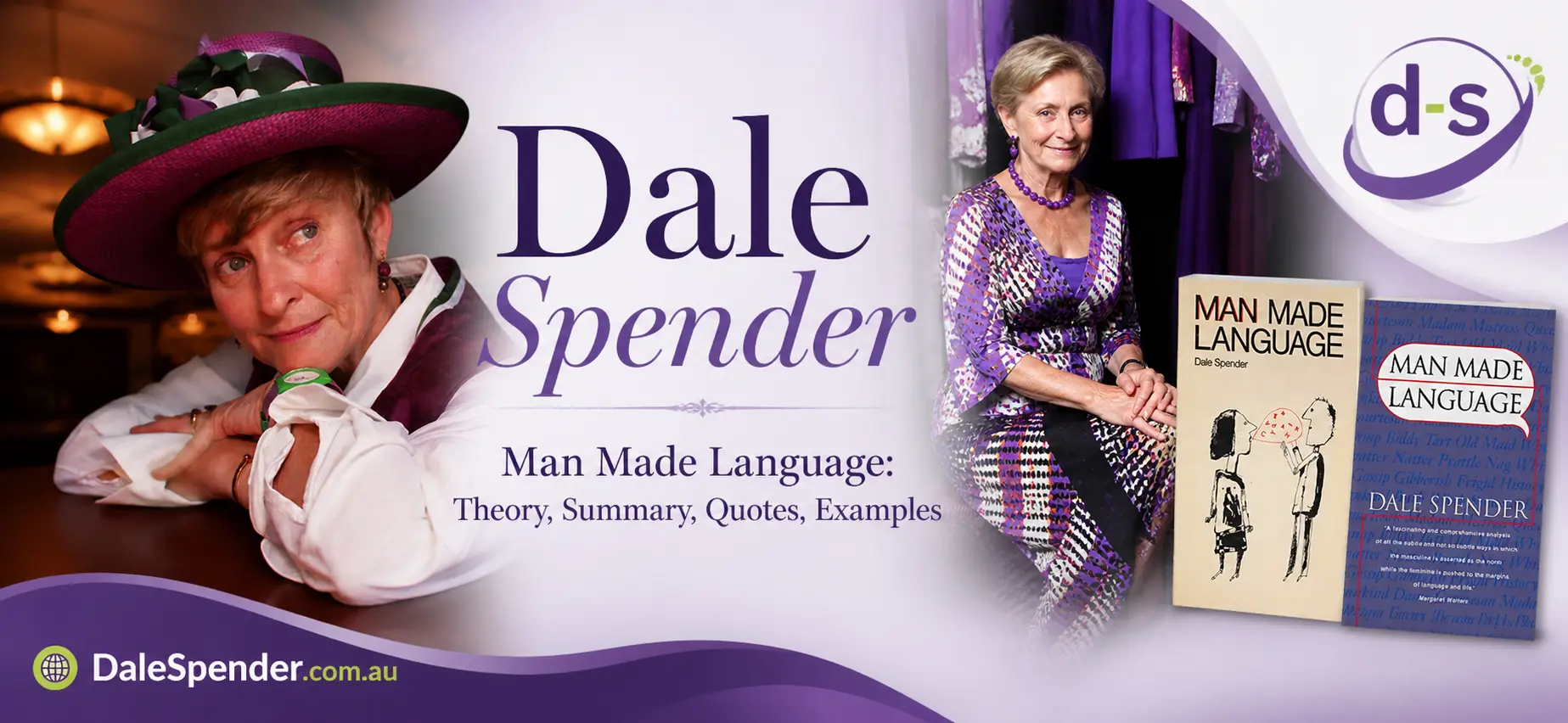
When Man Made Language was published in 1980, it quickly became one of the most discussed feminist books about language, gender, and power. Written by Australian scholar Dale Spender, the book argues that language is not neutral. Instead, it reflects and supports a male-dominated system where men are treated as the standard and women as secondary.
More than four decades later, the book is still widely read in feminism, linguistics, sociology, and gender studies.
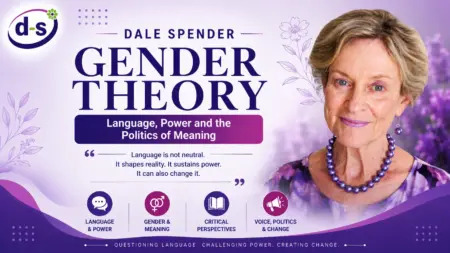
Dale Spender (born 1943) is an Australian feminist scholar, teacher, and writer. She has written over 40 books and has worked on projects related to women’s knowledge, publishing, and intellectual property.
Her 1980 book Man Made Language became one of her most influential works and remains a cornerstone of feminist language theory.
What Is Man Made Language About?
At its core, the book argues that:
- Men have historically controlled language.
- Language shapes how we understand reality.
- Because language was structured in a male-dominated society, it reflects male power.
- Women are often made invisible or secondary through linguistic systems.
Spender believes language does not just describe the world — it helps create it.
The Central Theory: Language Shapes Reality
One of the most important ideas in the book is:
Language helps form the limits of our reality. It is our means of ordering, classifying and manipulating the world.
Spender explains that every society creates “rules” for understanding the world. These rules become normal over time. In patriarchal societies, those rules often assume that:
- The male is the standard.
- The female is different or “deviant.”
- Male experiences are universal.
- Female experiences are marginal.
She calls this the “male-as-norm” rule.
The Male-as-Norm Concept
Spender highlights how language often treats men as the default human being.
Examples:
| Example | How It Reflects Male-as-Norm |
|---|---|
| The word “man” used for humanity | Suggests men represent the entire human species |
| “He” used as generic pronoun | Treats male as standard reference |
| “Mankind” | Centers men as the whole of humanity |
According to Spender, this system divides people into:
- Plus male
- Minus male
Women are defined in relation to men rather than as independent categories.
Silence and Women’s Voices
Another major theme in the book is the idea of women’s silence.
Spender challenges the stereotype that women talk too much. She argues:
The talkativeness of women has been gauged not in comparison with men but with silence.
This means:
- Women speaking at normal levels are often labeled “too talkative.”
- Men speaking at similar levels are considered confident or authoritative.
Spender also discusses how women’s experiences often lack words or recognition in language.
Language as Power
Spender makes a key distinction:
- Male superiority = a myth
- Male power = a social reality
The myth of male superiority justifies male power.
She explains:
By making it increasingly difficult to justify male supremacy we also make it increasingly difficult to justify male power.
This means that changing language can indirectly challenge power systems.
Key Themes in the Book
Here is a structured overview:
| Theme | Explanation |
|---|---|
| Patriarchal Order | Society structured around male dominance |
| Male-as-Norm | Male treated as standard human |
| Semantic Derogation | Words related to women often become negative over time |
| Silence & Invisibility | Women’s experiences ignored or unnamed |
| Politics of Naming | Whoever names reality controls meaning |
| Language & Reality | Language shapes how we see the world |
Important Quotes from the Book
Here are some powerful lines often discussed:
- “Language helps form the limits of our reality.”
- “We created the categories of male-as-norm and female as deviant.”
- “Language is both a creative and an inhibiting vehicle.”
- “We may use the English language our whole lives without noticing the distortions.”
These quotes show how deeply Spender connects language to power.
Why the Book Still Matters Today
Even today, debates continue around:
- Gender-neutral language
- Pronoun usage
- Representation in media
- Bias in textbooks and education
Spender’s work laid the foundation for these discussions.
Many modern conversations about inclusive language connect directly to ideas she raised in 1980.
Criticism and Debate
Like many influential books, Man Made Language has sparked debate.
Some critics argue:
- Not all language patterns are intentionally male-controlled.
- Language change is more complex than power alone.
However, supporters believe:
- The book successfully exposed hidden gender biases.
- It encouraged people to question “normal” language habits.
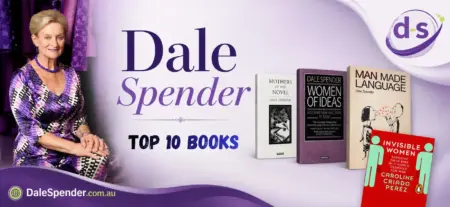
Read more: Top 10 Books by Dale Spender You Should Read
Man Made Language Book Details
| Detail | Information |
|---|---|
| Author | Dale Spender |
| First Published | 1980 |
| Pages | Approx. 250 |
| Genre | Feminism, Linguistics, Gender Studies |
| Rating | Highly rated by readers |
Where to Read the Book (PDF & Editions)
The book has been published in multiple editions (paperback and hardcover).
- Below are Digital Reading Platforms to read online books.
- https://archive.org/details/manmadelanguage0000spen_z0m7
- https://www.scribd.com/document/459774239/spender-dale-man-made-language-pdf
Man Made Language Summary in 5 Points
- Language is not neutral.
- Men historically shaped language structures.
- Male is treated as default human.
- Women are often invisible in language.
- Changing language can challenge power systems.
Man Made Language remains one of the most important feminist books about language and power. It asks readers to look at everyday words differently and question what seems “normal.”
Dale Spender’s core message is clear: “If language shapes reality, then changing language can help change reality.”
The book is not just about grammar — it is about power, identity, and how society is structured.