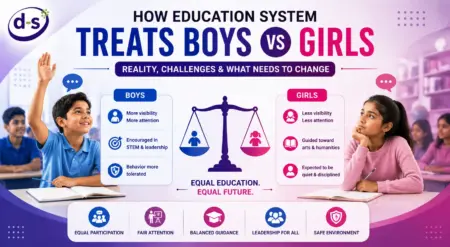



Education is supposed to give equal opportunity to every child. Classrooms are meant to be spaces where talent, curiosity and effort matter more than gender. Yet, when we look closely at how schools function, small differences in expectations, encouragement and attention can shape boys and girls in very different ways.
The issue is not always open discrimination. Often, it is subtle — hidden in language, behavior, classroom dynamics and long-standing social beliefs. Understanding these patterns helps us see how the system can improve.
Why This Topic Still Matters
Schools do more than teach subjects. They build:
- Confidence
- Communication skills
- Leadership ability
- Career direction
- Self-image
If boys and girls experience school differently, those differences follow them into adulthood.
Like to know? Who Was Dale Spender? Life, Books, Ideas & Legacy
Common Differences in School Experience: Overview
| Area | Boys Often Experience | Girls Often Experience |
|---|---|---|
| Classroom Participation | Speak more freely | Speak less despite preparation |
| Teacher Attention | More attention for behavior | Less direct encouragement |
| Discipline | Disruption seen as “normal” | Expected to be calm and polite |
| Leadership Roles | Take visible roles | Support roles more common |
| Subject Guidance | Encouraged toward STEM | Guided toward arts or care fields |
These patterns do not apply to every school or student. But they appear often enough to shape overall trends.
Classroom Participation: Who Gets the Floor?
In many classrooms, boys are more likely to:
- Raise their hands quickly
- Speak without being called
- Interrupt during discussions
Girls are more likely to:
- Wait to be invited
- Double-check answers before speaking
- Avoid taking up too much space
This difference does not reflect intelligence or ability. It often reflects confidence shaped by expectations.
The Participation Gap
| Behavior | Social Response |
|---|---|
| Boy speaks confidently | Seen as assertive |
| Girl speaks confidently | Sometimes labeled “bossy” |
| Boy interrupts | Seen as energetic |
| Girl interrupts | Seen as rude |
Over time, repeated reactions teach students what is “acceptable” behavior for their gender.
Subject Choices: Hidden Direction
Another difference appears in subject encouragement.
Boys Are Often Encouraged Toward:
- Mathematics
- Science
- Technology
- Engineering
Girls Are Often Encouraged Toward:
- Literature
- Arts
- Social sciences
- Care-related professions
These suggestions may seem harmless, but they influence long-term career paths. When guidance counselors and teachers unconsciously expect boys to excel in technical fields and girls to excel in expressive ones, students internalize those beliefs.
Like to know? Top 10 Books by Dale Spender
Discipline and Behavioral Expectations
Behavior is judged differently in subtle ways.
- Boys are often allowed more physical energy
- Girls are expected to be quiet and cooperative
When boys act out, it may be excused as normal behavior.
When girls act out, it may be treated as unusual or unacceptable.
This difference teaches students:
- Boys can take risks
- Girls should maintain order
The message affects how students see themselves.
Confidence and Risk-Taking
Confidence does not develop naturally. It grows through:
- Speaking opportunities
- Leadership chances
- Positive reinforcement
- Safe environments for mistakes
If boys are encouraged to take risks and speak often, their confidence increases.
If girls are praised mainly for neatness and obedience, their confidence in public expression may grow more slowly.
Confidence Development
| Factor | Impact on Boys | Impact on Girls |
|---|---|---|
| Speaking without preparation | Often tolerated | Often discouraged |
| Making mistakes publicly | Seen as part of learning | May reduce willingness to speak |
| Leadership practice | More visible | Less frequent |
Small patterns create long-term differences.
Higher Education Effects
By the time students reach college:
- Boys may dominate seminar discussions
- Girls may achieve high grades but speak less
- Leadership roles may still lean toward those with higher classroom visibility
The roots of these differences often begin much earlier.
Language in the Classroom
Language also shapes treatment.
Teachers may unconsciously use:
- Stronger praise for boys’ ideas
- Softer encouragement for girls’ participation
- Different tones when correcting behavior
Words matter. Over time, students absorb messages about value and ability.
Social Conditioning Beyond School
Schools do not operate in isolation. Society influences classrooms through:
- Parental expectations
- Cultural stereotypes
- Media representation
- Community beliefs
If society expects boys to lead and girls to support, schools may reflect those expectations unless actively challenged.
Signs of Progress
Many schools today are:
- Training teachers on unconscious bias
- Encouraging equal participation strategies
- Promoting girls in science and technology
- Creating leadership programs for all genders
Awareness is growing, but implementation varies.
What Needs to Change
To create true equality in education:
1. Equal Speaking Opportunities: Teachers can track participation to ensure balance.
2. Balanced Encouragement: Praise effort and ideas equally, not personality traits.
3. Leadership Rotation: Ensure both boys and girls lead projects and discussions.
4. Subject Neutral Guidance: Encourage every student in every field.
5. Safe Environment for Mistakes: Build confidence through supportive feedback.
| Area of Influence | Why It Matters |
|---|---|
| Classroom Interaction | Builds confidence |
| Subject Guidance | Shapes career paths |
| Discipline Policies | Reinforces expectations |
| Language Use | Influences identity |
| Teacher Awareness | Determines fairness |
Education does not only transfer knowledge. It shapes identity and ambition.
Read more: Dale Spender Gender Theory: Language, Power and the Politics of Meaning
The education system does not always treat boys and girls equally, even when equality is the goal. The differences are often subtle — embedded in classroom behavior, teacher responses and social expectations.
When schools recognize these patterns and actively promote equal participation, students of all genders benefit. True equality in education means not only equal access to books and exams, but equal space to speak, lead and grow.
FAQs
Do boys get more attention in classrooms?
In many cases, boys receive more behavioral attention and speaking opportunities.
Are girls academically weaker?
No. Girls often perform equally or better academically but may participate less verbally.
Why do girls speak less in class?
Social expectations and confidence patterns often influence participation.
Can schools fix this issue?
Yes, with awareness, balanced encouragement and structured participation methods.
Is the problem intentional discrimination?
Usually not. It is often unconscious bias and inherited social patterns.