

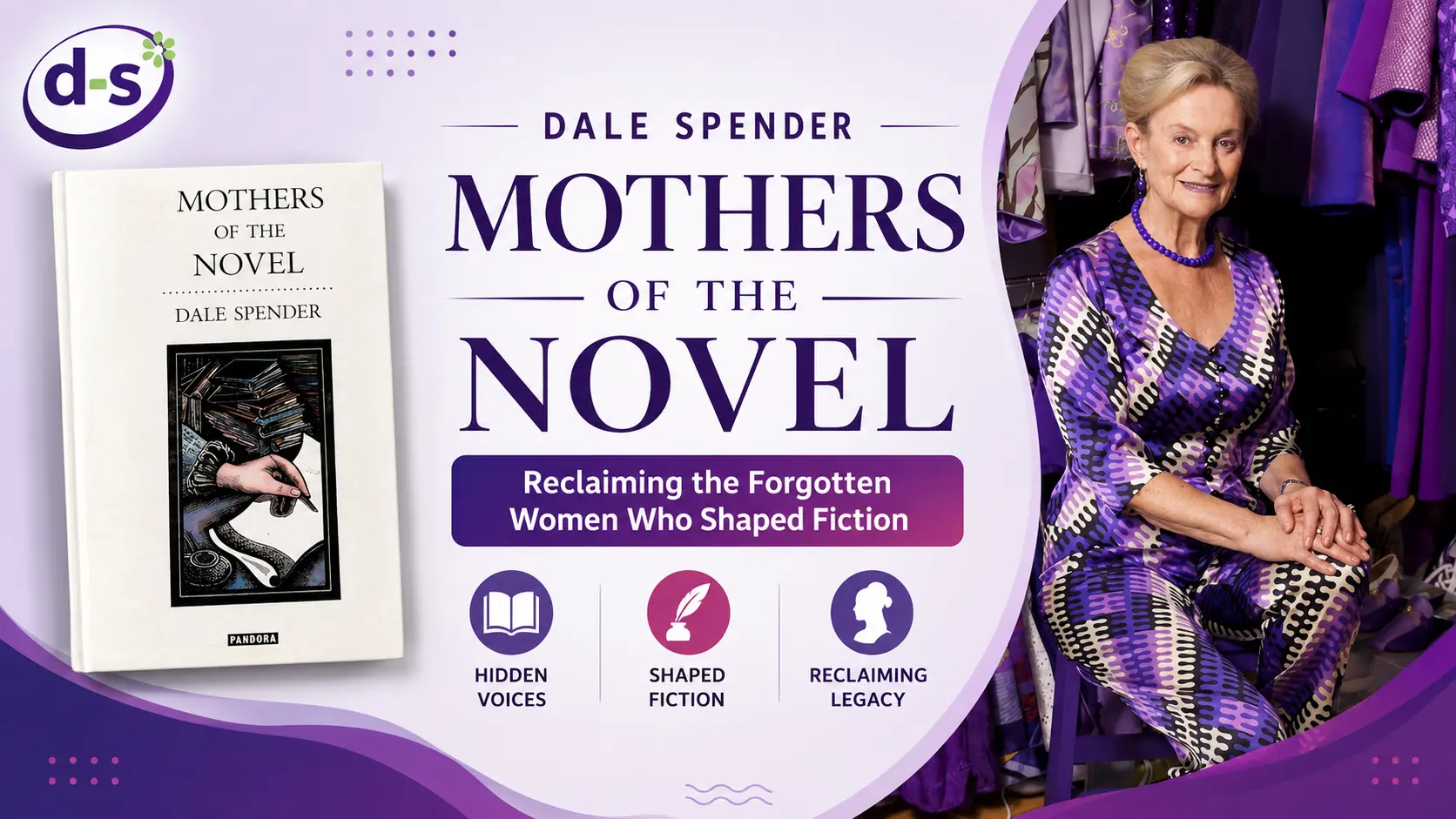
Dale Spender’s Mothers of the Novel: 100 Good Women Writers Before Jane Austen is one of the most important feminist literary works of the late twentieth century. Published in 1986, the book challenges a long-standing belief: that men invented the novel and that great fiction began with a few famous male writers.
Spender argues something very different. She shows that women were writing, publishing, and shaping fiction for more than 150 years before Jane Austen—and that their work was later pushed aside or forgotten.
This article explores the purpose, structure, arguments, and long-term impact of Mothers of the Novel in clear and simple language.
Why Dale Spender Wrote Mothers of the Novel
Spender noticed a serious problem in literary education.
Students were taught that:
- The novel “suddenly appeared” in the seventeenth or eighteenth century.
- A few male writers were responsible for inventing and shaping it.
- Women writers were rare, minor, or secondary.
Yet when Spender began researching early fiction, she found something shocking: hundreds of women had already been writing and publishing novels.
Instead of being exceptions, they were central to the development of fiction.
Her book became part of what is known as the feminist “reclamation project”—the effort to recover women’s lost contributions to literature and history.
What the Book Actually Contains
Mothers of the Novel is not just an argument—it is also a massive research project.
Spender lists:
| Feature | Details |
|---|---|
| Women novelists identified | 100+ early women writers |
| Total novels listed | 568 novels |
| Time period covered | 17th to early 19th century |
| Publication year | 1986 |
| Publisher | Pandora Press (London) |
The book is divided into three main parts.
Like to Know : Top 10 Books by Dale Spender You Should Read
Part I: Early Women Writers of the 17th Century
Spender begins with writers from the seventeenth century—long before Jane Austen.
Some key figures include:
- Lady Mary Wroth – One of the first women to publish fiction for money.
- Margaret Cavendish – A bold writer of poetry, philosophy, and even early science fiction. She faced ridicule for seeking public recognition.
- Aphra Behn – A hugely successful professional writer with dozens of works to her name.
- Anne Clifford, Lucy Hutchinson, Anne Fanshawe – Women who wrote biographies, memoirs, and historical accounts.
Dale Spender shows that these women were:
- Publishing widely
- Experimenting with dialogue and realism
- Writing political and social commentary
- Earning money from writing
This was not a quiet beginning. It was a vibrant literary culture.
Part II: The 100+ Women Novelists List
This section is one of the book’s most powerful contributions.
Spender presents:
- 106 early women novelists
- 568 novels written before Austen
Many of these names were almost unknown when the book appeared.
Writers such as:
- Eliza Haywood
- Sarah Fielding
- Charlotte Lennox
- Frances Burney
- Ann Radcliffe
- Charlotte Smith
- Mary Wollstonecraft
- Amelia Opie
Some were once bestsellers. Some were politically bold. Some were experimental. Yet most were removed from mainstream literary history.
Spender argues that their disappearance was not because of lack of quality—but because literary authority remained male-dominated.
Part III: Late 18th Century Women Before Austen
The final section focuses on major writers immediately before Jane Austen.
Spender makes an important point:
Jane Austen did not write in isolation.
She inherited:
- A strong tradition of women’s fiction
- Established narrative techniques
- Popular genres shaped by women
- Female readership networks
The idea that Austen created the novel from nothing is simply not true. She was part of an already rich tradition.
The Central Argument: The Myth of the Isolated Genius
One of Spender’s most famous arguments is what she calls “The Myth of the Isolated Achievement.”
Traditional literary history often presents:
- A few “great men”
- Working alone
- Inventing new forms
Spender shows that:
- Women were writing in large numbers.
- They influenced one another.
- They built networks.
- They shaped literary taste.
The erasure of women created the illusion that only men mattered.
Why Were These Women Forgotten?
Spender explains that women were excluded for many reasons, including:
- Literary gatekeeping by male critics
- Academic canon formation
- Publishing industry bias
- Social discomfort with ambitious women
- The assumption that women wrote only “domestic” fiction
Ironically:
- Some women were said to be “too scandalous.”
- Others were said to be “too domestic.”
- Some were “too political.”
- Others were “too conventional.”
Whatever the excuse, the result was the same: their names disappeared.
The Companion Reprint Series
Pandora Press also released a “Mothers of the Novel” series in the late 1980s.
It reprinted works by writers such as:
- Mary Brunton
- Frances Burney
- Maria Edgeworth
- Eliza Haywood
- Elizabeth Inchbald
- Charlotte Smith
- Amelia Opie
This made many previously inaccessible texts available again.
It was not only scholarship—it was restoration.
The Tone of the Book: Passionate and Polemical
Mothers of the Novel is not neutral or diplomatic.
Spender writes with:
- Energy
- Anger
- Enthusiasm
- Determination
Some readers feel the argument can be repetitive. But the repetition serves a purpose: she insists that exclusion was systemic, not accidental.
At the same time, the book is joyful. Spender delights in introducing readers to forgotten writers. Her excitement about discovery makes the book engaging rather than purely academic.
Like to Know : Dale Spender Gender Theory: Language, Power and the Politics of Meaning
Long-Term Impact
Since the book’s publication:
- Aphra Behn is now widely taught.
- Fanny Burney appears in documentaries and university courses.
- Eliza Haywood receives renewed attention.
- Early women novelists are more present in literary study.
There has been change—but not complete change.
Many writers listed by Spender remain unfamiliar to general readers.
Her work continues to challenge literary history.
Why Mothers of the Novel Still Matters
This book matters because it forces readers to rethink basic assumptions:
- Who created literary forms?
- Who gets remembered?
- Who decides what is “great” literature?
- How does gender shape historical memory?
Spender’s message is simple but powerful:
There is no good reason women should not stand equally in literary history.
If they are missing, something else explains their absence.
Final Thoughts
Mothers of the Novel is more than a list of forgotten writers.
It is:
- A challenge to literary tradition
- A recovery of women’s intellectual history
- A celebration of literary grandmothers
- A reminder that education is never complete
Dale Spender did not just recover names. She changed the way readers think about the origins of the novel.
The novel did not begin with a few great men.
It grew from a crowded, creative, determined community of women writers who shaped fiction long before Jane Austen ever picked up her pen.